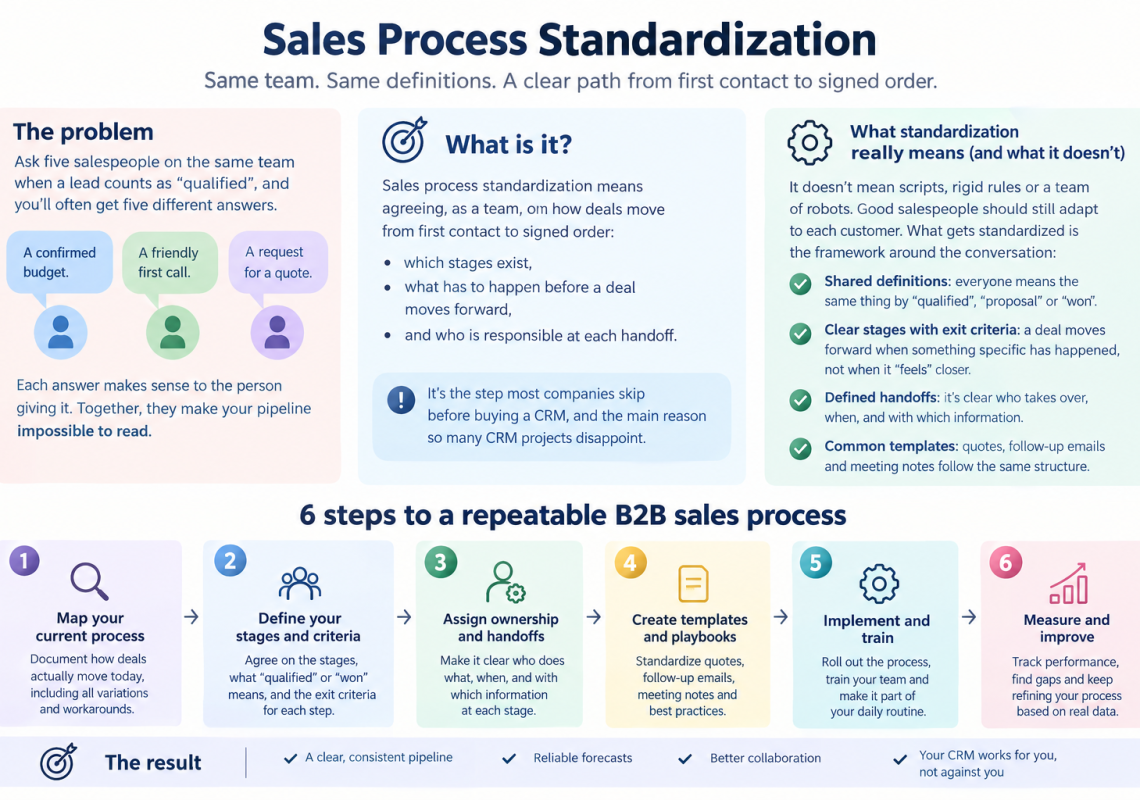
Ask five salespeople on the same team when a lead counts as “qualified”, and you’ll often get five different answers. One waits for a confirmed budget, another for a friendly first call, a third for a request for a quote. Each answer makes sense to the person giving it. Together, they make your pipeline impossible to read.
Sales process standardization fixes this. It means agreeing, as a team, on how deals move from first contact to signed order: which stages exist, what has to happen before a deal moves forward, and who is responsible at each handoff. It’s also the step most companies skip before buying a CRM, and the main reason so many CRM projects disappoint.
In our previous article, we looked at the hidden costs of manual sales processes. This guide shows how to build a repeatable B2B sales process in six practical steps, before you choose any tool.
In this article
- Why tools fail without a defined process
- What standardization really means
- 6 steps to a repeatable B2B sales process
- Before and after standardization
- Common mistakes to avoid
- From process to CRM
- FAQ
Why tools fail without a defined process
Buying a CRM before defining your sales process is like pouring concrete before drawing the plans. The system gets configured around whatever the team does today, including every inconsistency. Stages are named after habits, fields are added “just in case”, and nobody agrees on what the data means.
A few months later, the pattern is familiar: reports don’t match reality, salespeople keep their “real” pipeline in a spreadsheet, and management starts to wonder whether the CRM was a mistake. In most cases, the software isn’t the problem. The missing process is.
When the process comes first, the tool decision becomes much simpler. You know which stages to set up, which information to capture, which systems to connect and which steps are worth automating.
What standardization really means (and what it doesn’t)
Many sales leaders worry that standardization means scripts, rigid rules and a team of robots. It doesn’t. Good salespeople should still adapt to each customer. What gets standardized is the framework around the conversation:
- Shared definitions: everyone means the same thing by “qualified”, “proposal” or “won”.
- Clear stages with exit criteria: a deal moves forward when something specific has happened, not when it “feels” closer.
- Defined handoffs: it’s clear who takes over, when, and with which information.
- Common templates: quotes, follow-up emails and meeting notes follow the same structure.
The goal isn’t to make everyone sell the same way. It’s to make the results comparable, the forecast reliable and the best practices of your top performers available to the whole team.
6 steps to a repeatable B2B sales process
Step 1: Map your current process with the team
Start with reality, not with the ideal. Bring together the people who sell every day, plus someone from marketing and from delivery or project management. On a whiteboard, trace how a typical deal really moves: from the first inquiry to the invoice.
Mark every point where information is copied by hand, where a spreadsheet takes over, where a handoff gets lost or where a deal typically stalls. These marks are your improvement list. Two hours are usually enough to get a clear picture.
Step 2: Define lead and opportunity qualification criteria
Decide together what makes a lead worth pursuing. Keep it simple and specific to your business. For most B2B companies, four questions cover the essentials:
- Need: Does the company have a problem we can solve?
- Fit: Does it match our target customer profile (industry, size, region)?
- Authority: Are we talking to someone who decides or strongly influences the decision?
- Timing: Is there a realistic timeframe for a decision?
Write the criteria down and make them the same for everyone. A lead that doesn’t meet them isn’t lost; it goes into a nurturing list instead of cluttering the active pipeline.
Step 3: Set pipeline stages based on customer actions
This is the heart of sales process standardization. Each stage should describe what the customer has done, not how the salesperson feels about the deal. “Hot”, “warm” and “looks good” aren’t stages. They’re moods.
Here is an example structure that works for many B2B companies. Adapt the names and criteria to your own sales cycle:
| Stage | What the customer has done | Exit criterion (to move to the next stage) |
|---|---|---|
| 1. Lead | Made contact or showed interest (inquiry, event, referral) | First conversation scheduled |
| 2. Qualified | Confirmed need, fit and a rough timeframe in a first call | All qualification criteria met and documented |
| 3. Needs analysis | Shared requirements, involved further stakeholders | Requirements agreed; customer asks for an offer |
| 4. Proposal | Received a written offer | Customer has reviewed the offer and given feedback |
| 5. Negotiation | Discussing terms, scope or price | Verbal agreement on final terms |
| 6. Won / Lost | Signed the order, or decided against it | Order confirmed, or loss reason recorded |
Two rules keep the pipeline clean. First, a deal only moves forward when its exit criterion is met. Second, every lost deal gets a reason. Over time, loss reasons become one of your most valuable sources of insight.
Step 4: Define the handoffs
Most information gets lost between teams, not within them. Define three handoffs clearly:
- Marketing → Sales: When is a lead passed on, to whom, and how fast must sales respond?
- Sales → Delivery: Which information must be complete when a deal is won (scope, contacts, agreed dates, special terms)?
- Delivery → Account management: Who stays in touch with the customer after the project, and when are renewals or follow-up offers discussed?
For each handoff, name an owner and a short checklist. This is also where automation later delivers the biggest gains.
Step 5: Create standard templates
Templates turn good habits into defaults. Start with the documents your team creates most often:
- A quote or proposal template with fixed sections and current pricing
- Follow-up emails for the most common situations (after a first call, after sending an offer, after no response)
- A short meeting-notes structure: participants, needs, next step, date
Ask your best salespeople to contribute. Their proven wording becomes a starting point for everyone, and new hires benefit from day one.
Step 6: Document it as a lean sales playbook
Bring everything together in one short document: qualification criteria, stages and exit criteria, handoffs, templates and a few rules of thumb. Keep it to a few pages. A 60-page manual nobody reads is worse than a clear 5-page playbook everybody uses.
Treat the playbook as a living document. Review it every quarter with the team: what works, where deals still get stuck, and what should change.
Before and after standardization
Before
- Every rep defines stages differently
- Forecast built from gut feeling
- Information lost at handoffs
- Quotes built from old documents
- New hires learn by asking around
After
- Shared stages with clear exit criteria
- Forecast based on customer actions
- Handoffs with owners and checklists
- Consistent templates with current prices
- New hires follow a documented playbook
Common mistakes to avoid
- Too many stages. Ten or twelve stages look precise but slow everyone down. Five to seven is enough for most B2B companies.
- Copying another company’s process. A template is a starting point, not an answer. Your stages must reflect how your customers actually buy.
- Designing without the sales team. A process created only by management won’t be followed. Involve the people who use it every day.
- Standardizing everything at once. Start with qualification and stages. Templates and handoffs can follow in the next weeks.
- Never reviewing it. Markets, products and teams change. A process that isn’t reviewed slowly drifts back into individual habits.
From process to CRM
Once your sales process is standardized, you have everything a CRM project needs: the stages to configure, the fields that matter, the handoffs to support and the first tasks worth automating. You also have a team that understands why the system is set up the way it is, which is the best foundation for adoption.
In our next article, we look at the move from Excel to a CRM: when it’s time to switch, how to choose a system that fits your process and how to make sure your team actually uses it. [Link to Article 3 once published]
FAQ
What is sales process standardization?
Sales process standardization means defining one shared way for deals to move through your company: common qualification criteria, pipeline stages with clear exit criteria, defined handoffs between teams and standard templates. It makes sales results comparable and forecasts more reliable.
How many stages should a B2B sales pipeline have?
Five to seven stages work well for most B2B companies. Each stage should be defined by a customer action and have a clear exit criterion. More stages usually add complexity without adding insight.
Should we standardize our sales process before introducing a CRM?
Yes. A CRM configured around an undefined process usually reproduces existing inconsistencies. With a standardized process, you know exactly how to set up the CRM, which data to capture and which steps to automate.
How long does it take to standardize a sales process?
For a small to mid-sized sales team, the core elements (qualification criteria and pipeline stages) can often be defined in one or two workshops. Templates, handoffs and the playbook typically follow over the next few weeks.
Want help mapping your sales process?
genPsoft helps B2B companies define clear, repeatable sales processes and turn them into CRM systems and automations that teams actually use. In a free 30-minute call, we look at how your deals move today and show you where standardization will have the biggest effect.