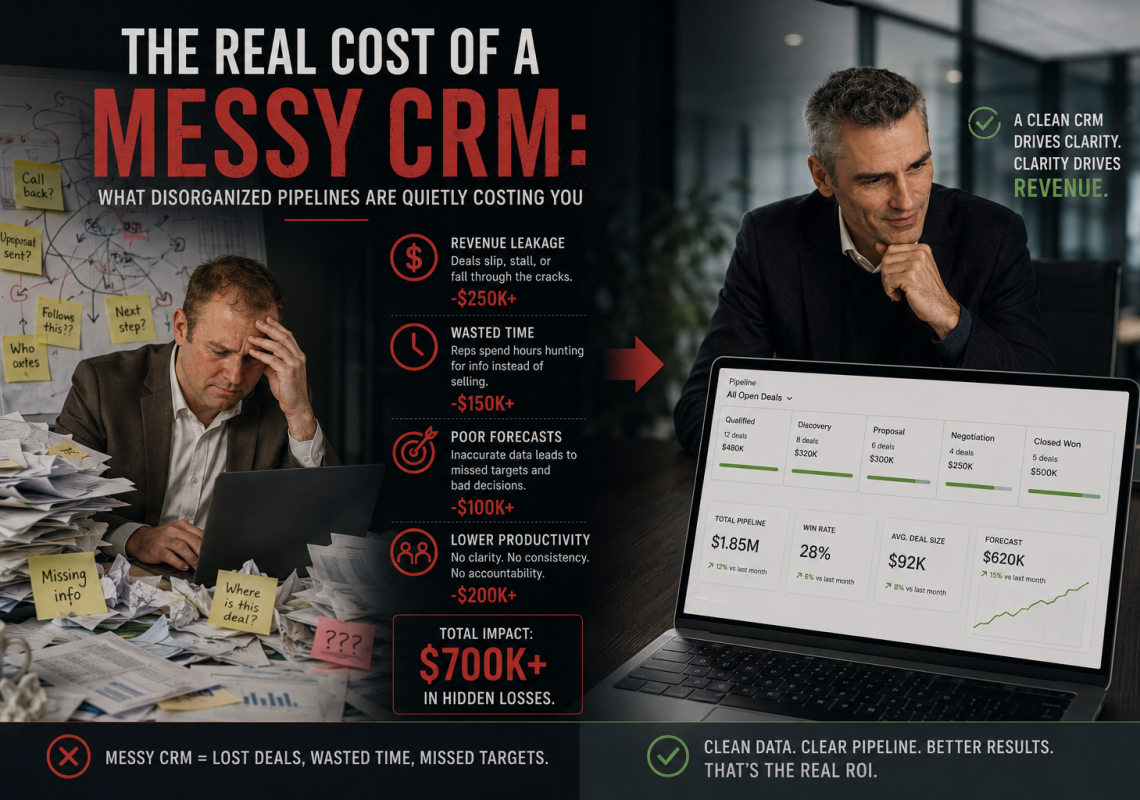
The Real Cost of a Messy CRM: What Disorganized Pipelines Are Quietly Costing You
Nobody budgets for a messy CRM. It doesn’t show up as a line item, nobody signs off on it, and no single person is responsible for it — which is exactly why it’s so easy to underestimate. A disorganized pipeline doesn’t announce itself with a big, visible failure. It just quietly taxes almost everything your sales team does, a little bit at a time, until the totals are large enough to matter and nobody can point to the exact moment it happened.
If you asked most sales leaders “what is a messy CRM costing you?”, the honest answer is usually a shrug and something like “it feels chaotic.” That’s not a number anyone can act on. Here’s a more useful way to think about it — and a framework for putting an actual figure on your own version of this problem.
Where the cost actually hides
1. Forecast errors that compound
A CRM full of stale, over-optimistic, or inconsistently updated deal stages produces a forecast that looks precise and isn’t. Leadership makes hiring decisions, budget commitments, and investor updates based on numbers that are, in practice, closer to guesses dressed up in a dashboard. When the quarter closes 20% below forecast, the cost isn’t abstract — it’s a hiring plan that has to be reversed, a budget commitment made against revenue that never arrived, or a credibility hit with people who were told to expect a different number.
2. Follow-ups that never happen
Every deal that goes quiet because nobody was reminded to follow up is a deal that was, at some point, live. A messy CRM makes this invisible: there’s no clean view of “which deals haven’t been touched in 10 days,” so nothing prompts anyone to notice. This isn’t a hypothetical inefficiency — it’s leads and opportunities that were paid for (through marketing spend, outbound effort, or inbound interest) and then quietly abandoned because tracking them required more discipline than the system provided.
3. Ramp time for new reps
When there’s no single source of truth for how deals should be logged, what “qualified” means, or what the next step should be at each stage, every new hire has to learn the process by osmosis — watching senior reps, asking around, guessing. That adds weeks, sometimes months, to the time it takes a new rep to become fully productive. Multiply the fully-loaded cost of a rep’s salary by the extra ramp time, across every hire you make in a year, and this alone is often the single largest hidden cost of a messy CRM.
4. Duplicate and wasted outreach
Without clean, de-duplicated data, the same prospect gets contacted by two different reps, or a lead that was already disqualified gets worked again from scratch. Beyond the wasted hours, this creates a genuinely bad experience for prospects — inconsistent, uncoordinated outreach is one of the more common reasons a promising lead quietly disengages before a deal even opens.
5. Reporting time that produces low-trust numbers
When the CRM data can’t be trusted, someone — usually a sales manager or ops person — ends up manually reconciling numbers in a spreadsheet before every leadership meeting. That’s hours of skilled time spent re-deriving information the CRM was supposed to provide automatically, and even then, the resulting numbers carry a permanent asterisk of “let me just double-check that.”
6. Institutional knowledge that leaves when a rep does
If deal history, objections raised, and relationship context live in a rep’s head and a scatter of personal notes rather than in the CRM, that knowledge walks out the door the moment the rep does — along with the account’s continuity. The next person picking up that relationship starts from close to zero.
Translating this into a number
You don’t need perfect data to get a useful estimate — you need a rough, defensible one. Here’s a simple framework:
Step 1 — Estimate lost deals from dropped follow-ups. Pull (or estimate) how many opportunities went quiet last quarter with no logged next step. Multiply by your average deal value and your typical stage-to-close conversion rate for that stage. Even a conservative estimate here is usually the single biggest number in this exercise.
Step 2 — Estimate the ramp-time cost. Take the difference between your average time-to-productivity for a new rep and what it should take with a clear, documented process. Multiply that gap (in months) by the fully-loaded monthly cost of a rep, times the number of reps you hired in the last 12 months.
Step 3 — Estimate the forecast-error cost. Look at the variance between forecasted and actual revenue over the last 2–4 quarters. Even attributing a portion of that gap (say, 25–50%) to data quality issues rather than market conditions gives you a directional number.
Step 4 — Estimate the manual reporting overhead. Hours per week spent manually reconciling CRM data for leadership reporting, multiplied by the fully-loaded hourly cost of whoever does that work, multiplied by 52.
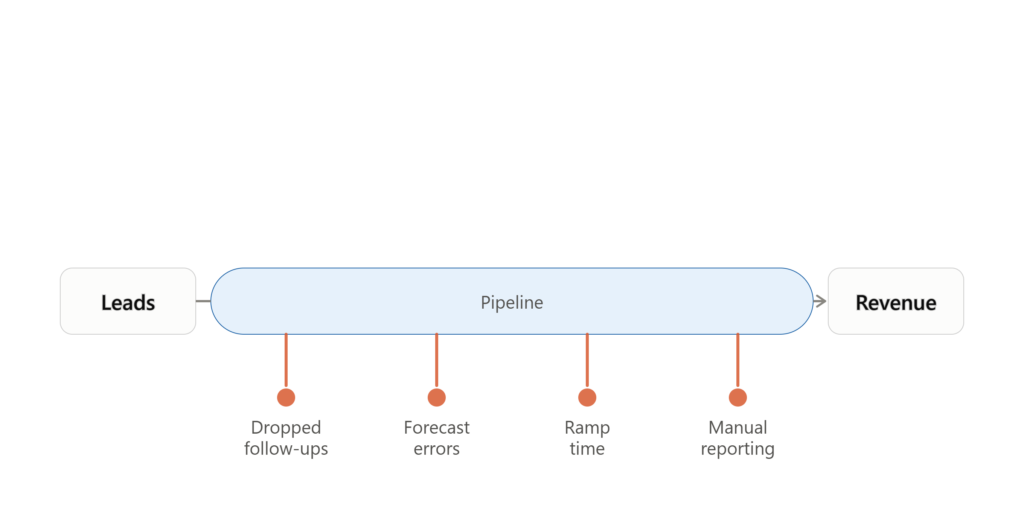
Add these four together, and you’ll usually land on a number that’s uncomfortably larger than “it feels chaotic” — often into six figures annually for a mid-sized sales team, even using conservative assumptions.
Why this framing matters
The point of putting a number on this isn’t to shame anyone — sales teams don’t drift into CRM chaos through negligence, they drift into it because nobody owns fixing it until it’s already expensive. The point is that “CRM cleanup” and “defining a real sales process” stop being nice-to-have hygiene projects and start being what they actually are: a specific, quantifiable cost center that’s currently being paid quietly, every month, instead of being fixed once.
Once you have your own rough number, the next question is almost always more useful than “should we get a better CRM?” — it’s “which of these four leaks would shrink the fastest with the least effort?” That’s usually where a fix actually starts.
Next in this series: the point where a spreadsheet genuinely stops being enough — and the specific signs that tell you you’ve crossed it.