
Why Most Sales Teams Don’t Actually Have a Process — They Have Habits
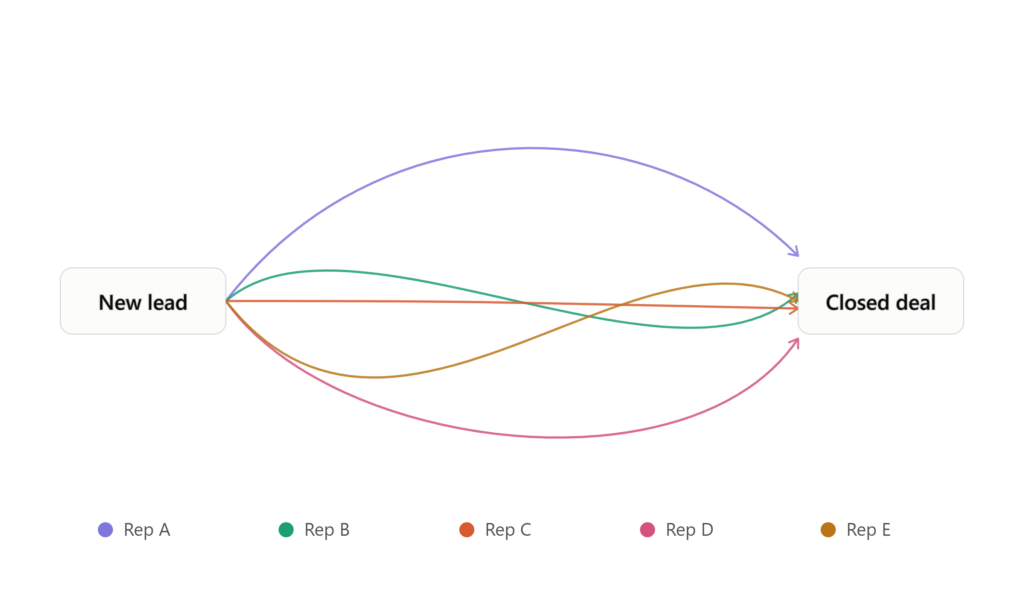
Ask five sales reps on the same team to walk you through their sales process, and you’ll usually get five different answers. Not five different phrasings of the same process — five genuinely different approaches. One rep sends a proposal after the first call. Another waits until the third. One qualifies budget upfront; another avoids the topic until it feels “natural.” One logs everything in the CRM; another keeps a mental list and updates the system once a week, if that.
On paper, all five are following “the sales process.” In reality, there isn’t one. There’s a set of individual habits that happen to produce, on average, enough revenue to keep the lights on — and everyone has quietly agreed not to look too closely at why some reps close 40% of qualified opportunities and others close 15%.
This is the gap that trips up more sales teams than any tool, market condition, or lead-quality issue: the difference between having a process and having habits that resemble one.
What a habit-based “process” actually looks like
Habits accumulate. Nobody sits down and designs them. A rep joins the team, shadows a senior colleague for a week, absorbs whatever that person happens to do, adds a few personal tweaks, and calls it their approach. Multiply that across a team and across a few years of hiring, and you get a sales org where the “process” is really just an average of everyone’s individual improvisation.
You can usually tell you’re dealing with habits rather than a process when:
- The answer to “what happens after a demo?” depends on who you ask. There’s no defined next step that applies regardless of the rep.
- Deals move between stages based on gut feeling, not defined criteria. A deal is “qualified” because a rep feels good about it, not because it meets specific, written criteria.
- New reps take months to ramp — and even then, ramp to a process, not the process, because the version they learn depends entirely on who trained them.
- Forecasts are consistently wrong in the same direction. If your pipeline is chronically over-optimistic, it’s often because “likely to close” means something different to every rep filling in that field.
- Post-mortems on lost deals rarely produce the same lesson twice. Without a consistent process, every loss looks like a one-off, so nothing structural ever gets fixed.
None of this means your reps are bad at their jobs. Talented individual sellers can absolutely out-perform a mediocre process through sheer skill and instinct. But that’s exactly the problem: the business is dependent on individual talent compensating for the absence of a system, which means performance is fragile, hard to replicate, and impossible to forecast with any real confidence.

What a real process actually defines
A sales process isn’t a values statement or a slide in the onboarding deck that nobody opens after week one. It’s a small number of concrete answers to concrete questions, applied consistently:
1. What are the stages, specifically? Not generic labels like “Discovery” and “Proposal,” but stages that map to how your buyers actually move through a decision — the stages should describe what the buyer has confirmed or done, not what the seller has said or sent.
2. What has to be true for a deal to move to the next stage? This is the part almost every “process” is missing. A stage move should require a specific, checkable condition: budget confirmed, a defined pain point acknowledged by the buyer, a next meeting booked with the actual decision-maker present. If a deal can move stages just because a rep felt optimistic after a call, the stage isn’t measuring anything.
3. Who owns the deal at each point, and what’s the expected next action? Every open deal, at any moment, should have a clear next step and a clear owner for that step. “Following up” is not a next step. “Sending the pricing comparison by Thursday and booking the follow-up call before ending today’s call” is.
4. What does a lost deal teach the team? A real process includes a lightweight, consistent way of asking why a deal was lost — not to assign blame, but to spot patterns. If three deals in a row stall at the same stage for the same reason, that’s not bad luck. That’s a process gap.
5. What data does the CRM actually need to hold — and why? Every field you ask reps to fill in should map to a decision someone will make with that information. If a field exists but nobody uses the data behind it, it will get filled in badly (or not at all), which quietly erodes trust in everything else in the CRM too.
Why this matters more than “getting a better CRM”
It’s tempting to treat this as a tooling problem — buy a more sophisticated CRM, and the process will follow. It rarely works in that order. A CRM can enforce a process once one exists (required fields, stage-gate automation, reminders tied to the next action). But a CRM cannot invent the process for you. Migrate an undefined, habit-based process into a new system, and you’ll simply have a more expensive, better-looking version of the same chaos — five reps, five approaches, now tracked in a nicer interface.
The order that actually works is the reverse: define the process first, even roughly, using the questions above. Then choose or configure the CRM to reflect and reinforce that process — not the other way around.
A short self-diagnostic
If you want a quick read on where your own team stands, ask a handful of reps these three questions separately, without letting them compare notes first:
- What has to happen for a deal to move from your second stage to your third?
- What’s your team’s average time-to-close, and how confident are you in that number?
- What made you lose the last deal you lost — and was that the same reason the last one was lost too?
If the answers vary significantly from rep to rep, or if nobody can answer question three with real confidence, you don’t have a broken CRM. You have a set of well-intentioned habits standing in for a process — and that’s a much more useful, and more fixable, thing to know.
Next in this series: what a disorganized pipeline is actually costing you in dollar terms — not “it feels chaotic,” but a concrete framework for putting a number on it.